
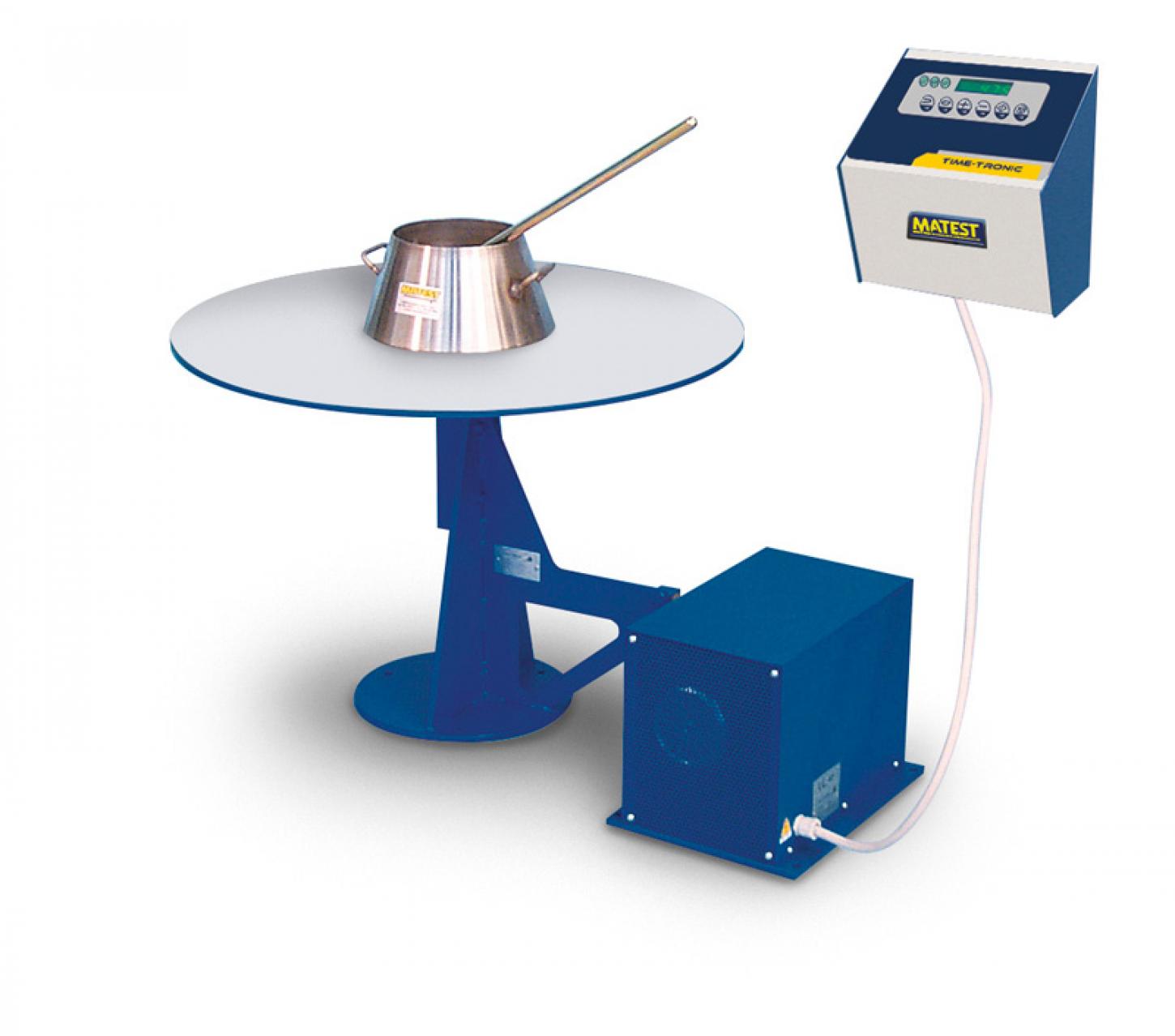
Flow Table Apparatus – Workability of Fresh Concrete and Mortar
The Flow Table Apparatus is designed to evaluate the consistency and workability of fresh cement, mortar, and grout by measuring the spread of the material under controlled vibration. The apparatus is widely used in construction laboratories to assess the flow characteristics of mixes, ensuring conformity to international standards such as ASTM C230, IS 1199, and EN 1015-3. The flow value, determined after a fixed number of drops, provides vital insight into the mix’s behavior during placement and compaction.
Key Features of Flow Table Apparatus
-
Workability Assessment: Measures the ability of cementitious mixes to flow and fill molds or forms without segregation.
-
Quality Control Tool: Assists in maintaining consistency and homogeneity in concrete or mortar mixes for reliable performance.
-
Compact & Minimal Design: Requires minimal components and space, making it ideal for standard lab environments.
-
High Fluidity Testing: Especially useful for evaluating high-workability concrete such as self-compacting mixes.
-
Precision Engineering: Cast bronze table with machined flat surface for repeatable and accurate flow readings.
-
Standards Compliant: Designed according to BS 4551-1, BS 3892-1, ASTM C230, IS 1199, and EN 1015-3.
Applications
-
Concrete Mix Design: Determine if a concrete mix is suitable for specific applications like pavements, walls, or formwork filling.
-
Grout and Mortar Testing: Ensures proper consistency for materials used in bonding, lining, or sealing applications.
-
Field and Lab Quality Control: Used to verify the batch-to-batch consistency during concrete or mortar production.
-
Construction R&D: Evaluate new formulations of cementitious materials for innovative building materials or additives.


Reviews
There are no reviews yet.